Accounts, Excuses, and Apologies, Second Edition: Image Repair Theory and Research by William L. Benoit
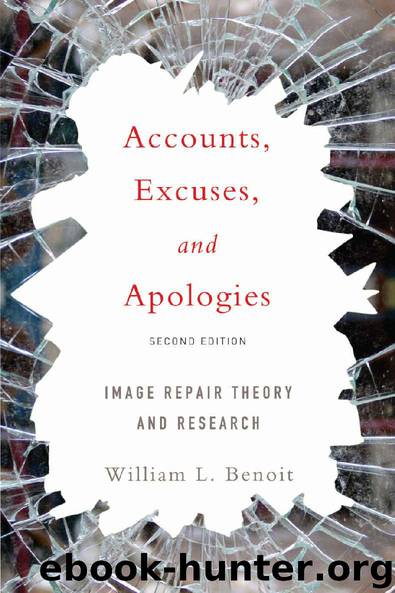
Author:William L. Benoit [Benoit, William L.]
Language: eng
Format: epub
Publisher: State University of New York Press
Published: 2014-10-14T22:00:00+00:00
New Orleans Saints Bounties
In 2012, the New Orleans Saints football program admitted to the existence of a “bounty” program in which players were paid bonuses to hit players from the opposing team so as to knock the other player out of the game (CNN, 2012; see also New Orleans Saints, 2012). Football is a contact sport, but creating financial incentives to intentionally injure opposing players is going too far. This practice is morally reprehensible; it would be bad enough for a player on his own initiative to try to hurt an opponent so badly that opponent would have to leave the game, but to institutionalize this practice by paying players bonuses for engaging in unsportsmanlike conduct deserves severe condemnation.
CNN (2012) reported on the accusations about the bounty program leveled against the New Orleans Saints football organization:
The National Football League reported Friday that the Saints paid defensive players a bounty for injuring opponents, as well as making interceptions and fumble recoveries, during the 2009– 2011 seasons. The program involved as many as 27 players and at least one assistant coach, the league concluded. The league said the program was administered by then-defensive coordinator Gregg Williams, with knowledge of other coaches. Players regularly contributed cash to a pool, which may have topped $50,000 at its peak. The players were paid $1,500 for a “knockout,” when an opposing player was not able to return to the game, and $1,000 for a “cart-off,” when an opposing player had to be carried off the field. In some cases, particular players on the opposing team were targeted.
This scandal damaged the reputation of the New Orleans Saints football team. Sports Illustrated (2012) declared, “Make no mistake: the New Orleans bounty saga will go down as one of the worst chapters in NFL history.” The team’s image was clearly damaged.
The New Orleans Saints responded with image repair discourse. Head Coach Sean Payton and General Manager Mickey Loomis issued a statement, saying they accepted “full responsibility” for this program, which “happened under our watch” (CNN, 2012). They acknowledged that these were “serious violations, and we understand the negative impact it has had on our game” (CNN, 2012). These statements illustrate mortification: Payton and Loomis admitted that an offensive action had occurred and they accepted responsibility for it.
Although the head coach and general manager accepted responsibility themselves, they were quick to deny that the Saints’ owner Tom Benson was involved in the bounty program. Payton and Loomis said they were “sorry for the ‘undue hardship’ the violations had caused Benson, ‘who had nothing to do with this activity’” (CNN, 2012). This can be considered a (brief) instance of third party image repair, where one party (Payton and Loomis) issues an image repair effort on behalf of a third party (Benson; see chapter 7 for more on third party image repair).
Payton and Loomis also made use of corrective action, declaring, “Both of us have made it clear within our organization that this will never happen again, and make that same promise to the NFL and most importantly to all of our fans” (CNN, 2012).
Download
This site does not store any files on its server. We only index and link to content provided by other sites. Please contact the content providers to delete copyright contents if any and email us, we'll remove relevant links or contents immediately.
Cecilia; Or, Memoirs of an Heiress — Volume 1 by Fanny Burney(32527)
Cecilia; Or, Memoirs of an Heiress — Volume 2 by Fanny Burney(31928)
Cecilia; Or, Memoirs of an Heiress — Volume 3 by Fanny Burney(31916)
The Great Music City by Andrea Baker(31902)
We're Going to Need More Wine by Gabrielle Union(19020)
All the Missing Girls by Megan Miranda(15892)
Pimp by Iceberg Slim(14464)
Bombshells: Glamour Girls of a Lifetime by Sullivan Steve(14039)
For the Love of Europe by Rick Steves(13823)
Talking to Strangers by Malcolm Gladwell(13332)
Norse Mythology by Gaiman Neil(13317)
Fifty Shades Freed by E L James(13216)
Mindhunter: Inside the FBI's Elite Serial Crime Unit by John E. Douglas & Mark Olshaker(9298)
Crazy Rich Asians by Kevin Kwan(9262)
The Lost Art of Listening by Michael P. Nichols(7480)
Enlightenment Now: The Case for Reason, Science, Humanism, and Progress by Steven Pinker(7288)
The Four Agreements by Don Miguel Ruiz(6729)
Bad Blood by John Carreyrou(6601)
Weapons of Math Destruction by Cathy O'Neil(6249)
